
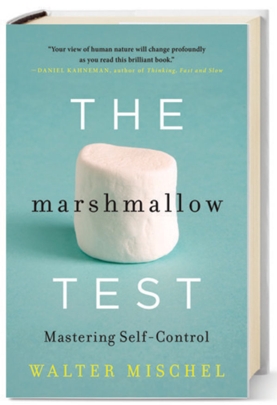
The Marshmallow Test: Mastering Self-Control

 Marshmallow Test Cover 2

Written by Walter Mischel, 336 pages, Little, Brown and Company (September 23, 2014)

Hardcover – $29, Softcover – $15, eBook edition – $15

Reviewed by Chris Wendel

In a Nutshell – A simple test determines so much. Is there hope for those of us that flunk it?

Who’s it for? – Anyone who simply wants more self-discipline.

Quote from author – “In order to understand self-control, and the ability to delay gratification, we need to grasp not only what enables it but also what undoes it.”

 A business book best seller when it hit shelves last year, I found “The Marshmallow Test” in the psychology section of my local Horizon Bookstore. My search demonstrates how broad the business book genre has become in the past decade. What today is defined as a business- related book goes beyond CEO biographies, Wall Street investment advice, and start-up business books. Business book or  not, “The Marshmallow Test” holds true to its premise that all good things come to those who wait.

Let’s establish from the get-go that author Walter Mischel is an accomplished university researcher. He first developed the much publicized Marshmallow Test in the 1960’s, at a Stanford University run pre-school. Researchers presented the children with the option of eating one marshmallow placed on a plate in front of them immediately by ringing a small bell –or- if the children were able to wait 10-20 minutes, they would be awarded with two marshmallows. The testing generally predicted the children’s ability to exercise self-control and the delay gratification.  Over time, those same children grew up and were tracked. It was determined that those who did well on the Marshmallow Test had better social and cognitive development, achieved higher SAT test scores,  and had better self-worth later in life.

“The Marshmallow Test” also explains why a person may lose their composure in a particular situation is not an indicator of how they will respond in all situations. The philandering politician, who has the ill-advised affair with an office intern, can still work at a high level in important decision making situations. In other words, the snapshot collection of small moments that we all judge others by is not an accurate portrayal on how that person deals with situations across a broader spectrum.

Well explained biopsychology helps us understand our reactions to situations that challenge our will power and desire for instant gratification. This self-control is a psychological battle between the “hot” reactive part of the brain that traditionally dealt with primal danger and the “cool” more developed portion of the brain’s frontal lobe that rationalizes situations.

Situations that touch off a hot reaction (or lack of self-control) can be quelled by a refined cool system.  Techniques that teach one to focus on future ramifications in these situations can be developed over time, reducing the negative consequences of short-term temptations.

Mischel makes it clear that in our early years some of us are better than others at resisting temptation and regulating painful emotions. What gets a bit lost in the initial summary is that willpower skills can be improved significantly. It’s a relief to understand that we (and our children) don’t have to be pigeon holed into any permanently defined categories of behavior.

For most businesses, a premium is placed on hiring employees who can demonstrate self-control and discipline in a variety of situations. “The Marshmallow Test” in this context can be a valuable tool for choosing and developing talent.

“The Marshmallow Test” translates years of detailed research into information that readers will find both interesting and relevant.  For author Mischel, his book is part career retrospective, part self-improvement book.  His story of quitting his two-pack a day smoking habit makes the previously laid out research seem more realistic. Like the four year old children who are able to exhibit inventive techniques for delaying gratification, “The Marshmallow Test” offers strategies and hope for those with limited self-control .

Chris Wendel is an author, commercial lender, and business consultant living Traverse City, Michigan. He can be reached at cwendel@sunbearpress.com.
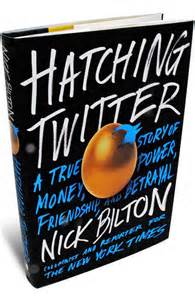
Book Review: “Hatching Twitter

Hatching Twitter

A True Story of Money, Power, Friendship, and Betrayal

Hatching Twitter Cover

Written By Nick Bilton

2013, Portfolio Trade, 320 pages

Hardcover $17.00, eRead version $7.99

Reviewed by Chris Wendel

Four out Five Stars

Most of us have an image of an inventor shaped by the works of Edison, Bell, and the Wright Brothers:  Hardworking souls toiling through hours of experiments until a groundbreaking innovation is discovered. Such is not the case for the founders of the social online networking service Twitter. Through the entertaining book “Hatching Twitter” by Nick Bilton, we’re able to see firsthand how the success of Twitter is more happenstance melodrama than relentless persistence.

Bilton, a New York Times columnist and writer, researched thousands of Twitter documents including employee emails, boardroom presentations, government communications, newspaper articles, and blog posts. Weaving these accounts together he created a fascinating chronology of how Twitter’s founders changed (intentionally or not) the world.

“Hatching Twitter” begins with short chapters on each of Twitter’s founders, drawn together by the desire to create something that will make them notable and rich. Evan Williams is the misunderstood son of a Nebraska farm family who migrates out west to Silicon Valley.  He eventually starts the web site Blogger, which he sells to Google. Williams parlays his Google windfall into a podcasting business which his friend Noah Glass convinces him to invest in.

The business, initially known as Odeo, at first operates in make shift work spaces, going between a small cramped office and a small apartment. New employees are hired in, each with unique skill sets and personality quirks. One of these hires, Jack Dorsey begins his work as a lowly contract programmer, his significance to the future of Odeo and Twitter is unanticipated.

Odeo works to position itself as the go-to application for podcasting. One night its plans are blown to pieces when Steve jobs announces that Apple is introducing the i-Pod, which includes a major podcasting platform. Odeo’s grand vision now destroyed, Williams calls a meeting to brainstorm what the company can do to survive and appease its investors.

It’s a 2 am conversation the following morning between Glass and Dorsey that takes the idea of text messages that can be broadcasted to a broad audience. Facebook is trying a somewhat similar concept on college campuses, but Glass and Dorsey seek a way to communicate their thoughts to friends that are not close by as a solution to their own loneliness.

The concept is tweaked at meetings that follow and a new direction is forged. The next question is what to call the new company.  Before Twitter was selected, we learn that names like Worship, Quickly, Tremble, Friendstalker, Vibrate, Twitcher, and Twitchy fortunately did make the cut.

Growing pains persist throughout the early months of Twitter. The company gains followers slowly at first. Twitter’s first marketing rollout event is at a disaster, but over time “tweeting” becomes trendy and hip and Twitter popularity worldwide.

As this growth accelerates, the company’s servers have persistent problems keeping up with the site’s burgeoning traffic. Investors become antsy with the technical issues but there are always new investors waiting at Twitter’s door step. The book’s more humorous episodes include failed and bizarre individual attempts to invest in the company from Al Gore, Ashton Kutcher, and Mark Zuckerberg (Facebook).

While Twitter is evolving so are the egos of its founders. Key players may be fired from Twitter but the inept staff left to manage become vulnerable themselves, resulting in a corporate environment that violates every administrative and human resources curriculum ever written.

We learn this from the Twitter story. Bad relationships chronically fester within even a successful business. People are willing to invest in a company even when it produces zero income for several consecutive years.

We also learn that the crazy and unlikely story of Twitter is extremely entertaining. “Hatching Twitter” is well written in a style lends itself to the drama and storytelling of a good movie script. Which may be author Bilton’s overarching intent.

Chris Wendel is with Northern Initiative in Traverse City.  Based in Marquette, Michigan, Northern Initiatives provides entrepreneurs with access to capital, technical assistance, and new markets throughout northern Michigan. http://www.northerninitiatives.com