Book review: Like a Virgin, by Richard Branson

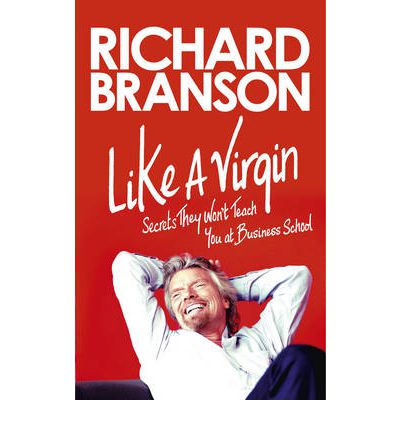
Like a Virgin by Richard Branson

Secrets They Don’t Teach You At Business School
Richard Branson

By Richard Branson

Portfolio/ Penguin Books

Published September 25, 2012

Softcover – $16.00, Kindle Version – $9.99

Reviewed by Chris Wendel

4 out of 5 Stars

Sir Richard Branson, the internationally famous entrepreneur, adventurer, and self-proclaimed icon has the distinction of being the only person in the world to “have built billion-dollar companies from scratch in eight different sectors”. As you can guess there’s some ego to get past here with Branson’s latest book, Like a Virgin. But as Walt Whitman once said, “If you’ve done it, it ain’t bragging”. Well, it’s safe to say that Branson has accomplished enough for him to be able to what say just about anything he feels like expounding on.

With this in mind, one also has to appreciate the walking handbook quality of this sometimes random, but incredibly insightful book. Learn from my mistake, and don’t try to plow through Like a Virgin, thinking that one chapter is a building preamble flowing effortlessly from one topic to the next.

Instead, I recommend taking a look at the book’s Table of Contents and using it more as a reference guide to issues that you have experienced or may have now with your business situation. This can be from the perspective of an owner, investor, or employee. There are roughly 75 different topics covered with these short vignettes. Having the perspective of someone like Branson, who has such a thorough and successful background, makes Like a Virgin a stellar resource. Here are some examples of the varied subjects and content:

The Perfect Pitch, provides best practices for anyone trying to raise money for a business or project. Branson has been on both sides of this table, and presents a no-nonsense approach that rationally explains the motives of both the investor and the borrower.

More Walking and Talking. Less Typing and Griping, will strike a chord with many stuck in office or professional situations where a key player would rather send a passive aggressive email than simply pick up the phone and effectively communicate. Anyone who has experienced the email that creates more questions than answers (and the resulting, time-sucking politics), will relate to this section.

Kick Start The Economy, lists 10 tips for jump starting the economies of the world, complete with a common sense prescriptions for what needs to be done and who needs to do it. Branson is certainly qualified to weigh in on this from his experiences.

The topics covered are up-to-date and wide ranging. This is guts of the book, and the insight from Branson is many times humorous and but always honest. It’s interesting to hear Branson admit and explain details of the businesses he started and that failed.

Branson also takes time to look back at others that have inspired him along the way, acknowledging that Steven Jobs is perhaps the greatest entrepreneur of all time. He believes that Jobs built his customer loyalty around innovative products. Branson then explains that the only way he knew how to succeed was to build his business around customer service. It’s these customer opportunities and recognized voids in the marketplace that are the inspiration for Branson’s diverse (in terms of product) business concepts.

Don’t get the idea that Like a Virgin is heavy on ground breaking business theory. The point is that Branson is a true entrepreneur that is able to innovate and adapt like no one else. I couldn’t help but imagine sitting down with Branson at a pub or coffee shop and having the ability to ask him anything about building a successful business. If that were to ever happen, the transcript from that conversation would sound something close to the content of Like a Virgin.  Like any storyteller, you might hear a few things more than once (Branson mentions multiple times how he started a music magazine), but that’s a minor demerit. If you’re looking for a refreshing alternative to the mindless drivel of most mass produced business books, Like a Virgin is a great choice.
Book Review: How Starbucks Saved My Life

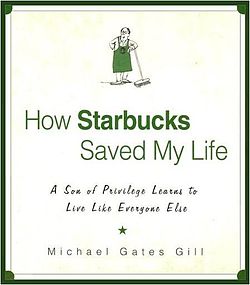
HOw Starbucks - image

How Starbucks Saved My Life

A Son of Privilege Learns to Live Like Everyone Else

Gotham Books, 2007, 267 pages

Softcover, $14-, Kindle, Nook Version, $11.99

Reviewed by Chris Wendel

4 out of 5 stars

Life does not always allow us the time for all of the books we want to read. I remember hearing about “How Starbucks Saved My Life” when it was published in 2007, but had forgotten about it until I saw it recently at Horizon Books in Traverse City. I have grown somewhat weary of business books that reveal a magical concept and spend the remaining chapters reinforcing their supposed revelations. Something told me this book would be different.

Michael Gates Gill, author of “How Starbucks Saved My Life” was born into wealth. He graduated from Yale and immediately got a job through his network of college classmates for the major advertising firm J. Walter Thompson. Accomplished professionally with a large mansion and six figure salary, he seemed to have it all. Until his world comes crashing down and he finds himself in his 50’s, unemployed, divorced, and diagnosed with a brain tumor.

One day, lost in his post privileged life, “Mike” finds himself in a Starbucks coffee store, pretending to have an important meeting with someone who will never arrive. On a whim the store’s manager approaches and asks him if he is interested in working there. The manager is a young African American woman who Mike has little in common with. Desperate (and now broke), he takes the job, learning quickly how his pedigree doesn’t matter to his new boss or co-workers.  It is the jolting realization that making a living now puts him on equal footing with people he used to dismiss as uneducated or inferior. This moment forms the controlling  of the book.

“How Starbucks Saved My Life” is an entertaining first person narrative, going back and forth between Mike’s daily struggles to learn and keep his job as a coffee barista and flashbacks to the baggage of his upbringing, corporate life, and deep rooted biases. The book’s one drawback is the author’s habit of interrupting the flow of pivotal present tense situations with elongated and sometimes wordy flashbacks.

So how does Starbucks play into this? Like them or not, Starbucks provides the well-honed procedures and infrastructure that allow people to perform at a very high level, regardless of age or experience.  Mike’s well healed background matters little when it comes time to clean the restrooms, or deal with a long line of customers (or “Guests” in Starbuckese). However, within the Starbucks culture, Mike and each of his Partners are allowed to find some individual areas of expertise within the structure.

Over time the younger Partners and Mike become personally close. Mike finds that working at Starbucks is the great equalizer. Once that is understood, he truly appreciates the differences and strengths of each of his Partners.  Once this happens, Mike realizes something else.  That he is as happy as he has ever been, and that’s saying a lot.

Working as a team with defined daily tasks and goals, Mike and his team achieve a tremendous level of camaraderie and job satisfaction. In the end Mike is surprised when one day his grown children come to visit him at Starbucks are tremendously proud of his new line of work, his acceptance of others, and the way he’s changed him for the good.

“How Starbucks Saved My Life” is really about a courageous man who is forced to reinvent himself and be humbled in order to simply make a living. The real story here is Mike’s ability to excel as a Starbucks barista, while reaching a level of satisfaction in his work that he never had as a high-level advertising executive. In its small 260 page format, “How Starbucks Saved My Life” is a highly entertaining, weekend read that might just change your life… just like it changed Mike’s.

Linchpin, Are You Indispensable?

Book Review by Chris Wendel

Seth Godin is one of the most influential business writers of the last decade, with a litany of relevant topic books  (Tribes, Small is the New Big, Permission Marketing, Purple Cow) and his latest offering LINCHPIN, (Are you indispensible?), which addresses the ultimate role a person plays with their own professional life.
This subject is timely given the dramatic shift in work force parameters in the past two years. Long gone are promises of long-term stability with any position it seems, and Godin is quick to point out the sources and solutions to this phenomenon.

According to Godin, in the beginning (Genesis reference intended) our American education system was created for us to be trained and prepared for jobs where we are essentially a cog in a wheel, doing what is dictated, with the reward of long-term security and a decent salary.

Corporate owners for years sought ‘compliant, low-paid, replaceable, cogs to run their efficient machines”. This model according to Godin persisted until recent economic upheavals made the dynamic dysfunctional for many modern day workers.

This is amplified by the advent of out-sourcing of work offshore and further mechanization of many human work tasks. Today, the working class generally is never guaranteed a job, is paid relatively less, and must be more versatile in order to survive, let alone thrive. This also includes management employees that are paralyzed by efficiency driven policies that are guided more by stockholder earnings than a regard to long-term employee loyalty.

A third team has emerged during this time that Godin appropriately labels “linchpins”. Linchpins make themselves invaluable by creating relationships, adding an artistic element to their work, and creating new ways of doing things. Imagine there are no bounds to your creative abilities. Now imagine the work you did everyday included this creativity and the opportunity to include artistic expression into it as well.

After the consummate background that explains the evolution of the linchpins, Godin uses biopsychology, easy to adapt skills, and honest challenges to readers to change their mindset and unleash their artistry and unique genius. Incorporating many of these hidden skills is essential to both finding one’s niche in the new workplace and sustaining job satisfaction.

Linchpins have the opportunity going forward to “invent, lead (regardless of title), connect others, make things happen, and create order out of chaos”. Godin solidifies his theory with compelling references from recognized and respected experts. Too many on-topic business books form a first chapter premise and spend the rest of the reader’s time dwelling on repetitive regurgitations. Godin’s writing style however, is conversational and relevant in a short sectioned-out formats that flow easily from one to another.

LINCHPIN, Are You Indispensible? is an essential read for anyone who finds themselves at a professional crossroads, and can take the time to identify what it will take to be a building block in a great organization and to love their work at the same time.

Book Review: The Long Tail: Why the Future of Business Is Selling Less of More

Reviewed by Chris Wendel

  • Hardcover: 256 pages
  • Publisher: Hyperion; First Edition edition (July 11, 2006)
  • Softcover: $12.00
  • Electronic (Kindle, Nook, or other electronic versions): $3.00
  • 4 ½ out of 5 stars

Over the past few years, I’ve reviewed business related books in their order of relevance to the audience of the Traverse City Business News. There are plenty of poor business books out there but, I’d rather not waste time trashing a book that readers would likely not read anyway.  With that in mind, let’s look at a book that’s one of my favorites.

In 2004 Wired Magazine writer Chris Anderson wrote an article describing the niche business strategies of companies such as Amazon.com and Netflix. The article begat a book entitled: The Long Tail: Why the Future of Business Is Selling Less of More, and is considered by some to be one of most impactful marketing of the past decade. The Long Tail digs deep to describe the market opportunities today that are imperative for entrepreneurs and business owners to deploy.

The Long Tail describes how we have moved from an information age of a few big selling products to an age of choice that sells a large array of products sold in small quantities. It is the death of this “common culture” where everyone likes the same things that Anderson celebrates.

Today’s endless choices form a marketplace where many different products make up the majority of customer demand. This is the opposite of 20-50 years ago when a few blockbuster or smash hits made up 90% of the entire market. This scarcity was because distribution was limited to a finite number of theatres, bookstores, and record store shelves.

With more choices come opportunities for small business to realize a profitable market share in a short period of time. The catalyst for this shift is the internet which broke down the traditional barriers of distribution and whetted the appetite of consumers to demand products that closely match up with their individual personas. Web sites can offer an endless number of inventory items and authors can successfully (sometimes) publish titles in relatively small quantities while finding loyal readers and profit producing sales.

While the Information Age created the mechanism for The Long Tail, market demand today is predicated less on targeted marketing efforts to a perceived audience and more on permission based models where consumers spread the word of new and unique products through blog postings, social networking, and email.

Not convinced? Consider the small indie band described in the book that turns down a national recording deal realizing that they can market more effectively and reap larger profits operating on their own. Closer to home  there’s the proliferation of older local theatres being renovated throughout rural Michigan. The demand for more diverse movie offerings created a unique form of economic development in towns like Traverse City, Frankfort, Manistee, and Boyne City.

When it’s all said and done, it is clear that Anderson is a gifted writer who can make sense out of technically advanced information, presenting in a pleasant conversational manner intricate topics that combine statistical trends with good old fashion storytelling.

So, how has The Long Tail held up over the years? The publishing business remains at a crossroads with the advent of on demand printing. Retailers big and small continue to diversify into more defined niches. The only notable exception could be the music industry where Wired magazine (remember, this is where Anderson was employed when The Long Tail was written) recently reported that 1% of performing artists today generate 56% of the concert revenues for U.S. concert revenues.  Although plenty of people pay to listen to Indie music, others will still pay the big bucks for an A list musician at a large concert venue.  Regardless of where the trends go from here, The Long Tail should be required reading before any company considers its marketing strategy.

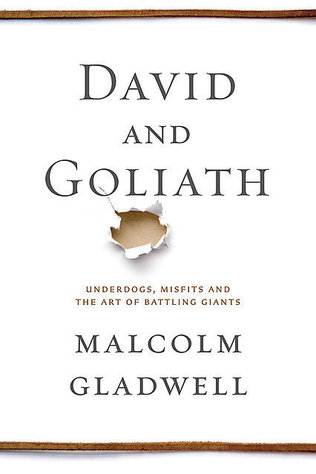
Book Review: David and Goliath

David and Goliath

Underdogs, Misfits, and the Art of Battling Giants

By Malcolm Gladwell

David Goliath pic

Little Brown and Company, 2013

305 pages

Hardcover: $29

E-reader version: $13

Reviewed by Chris Wendel

Bestselling author and speaker Malcolm Gladwell has written several popular books studying human behavior and its impact on social phenomenon and trends. Gladwell’s ability to look at commonly held beliefs, and do the deep dive dispel or prove that these predominant viewpoints have earned him the accolade on Time magazine’ list of most prominent people.

In Gladwell’s book The Tipping Point, he explains that magic moment when an idea, trend, or social behavior crosses a threshold, tips, and spreads like wildfire.  In Outliers Gladwell highlights the 10,000 Hour Rule which posits that it takes about 10,000 hours of dedicated practice to truly master a skill be it playing the violin, computer programming, or skateboarding.

Over the past decade Gladwell has created his own sub-genre of social behavior related books. His latest offering, David and Goliath, demonstrates a similar strategy, taking mundane research and weaving it into a story that just about anyone can enjoy. A true David versus Goliath situation Gladwell explains, is not always as one sided as it appears.

These favorite/ underdog relationships go down unexpected paths when Gladwell relates it to grade school class size (a popular discussion with parents) and the point in which more money and resources leads to limited return on the investment. Gladwell delves into the topic of dyslexia and explains how in many cases this disadvantage was used to help notable people grow and accomplish things not possible without the condition including serial entrepreneur Richard Branson and investment tycoon Charles Schwab. Gladwell also identifies the surprising success of prominent individuals who succeeded despite losing a parent, including an amazing 12 of the 44 US Presidents. Each of the book’s chapters present the possibility that people facing a major disadvantage can use that shortcoming to propel them to heights they otherwise would not have achieved.

The book’s most absorbing story chronicles a group of doctors’ fight against childhood leukemia. In the early 1960’s the disease was running rampant and children with leukemia were given little chance of survival. Through determined and bold experimentation, while remaining courageous in the face of harsh criticism, the doctors were able to identify a combination of drugs that over time increased the cure rate for this type of cancer to 90%.

So, how does this all relate or pertaining to our local economy or what each or does on a daily basis? At the very least David and Goliath provides inspiration to any of us that face challenging goals and tasks, especially in an environment of limited resources and high expectations. In many respects, it’s certainly easier for a smaller company today to have a web presence that to a consumer looks just as big and just as successful as a larger corporate competitor.

This changing landscape of markets and with the ability of local companies to sell their goods and services nationally or to a worldwide audience makes it apparent that there is an opportunity for small companies to gain a competitive vantage quickly. We now live in a niche oriented society that seeks out specialized products and services that can be created by relative underdogs. Like Seth Godin’s book Tribes or the The Long Tail by Chris Anderson, the underdog role has been a reoccurring one for some time now.

The lessons to what Gladwell calls “Theory of Desirable Difficulty” turn the tables some on the traditional underdog relationship. Gladwell’s nine chapters break this down into a reframing exercise that makes it easier for a small business or organization to take on their own Goliaths.

Gladwell’s has come under heavy scrutiny of late for his broad generalities. Even if there are some holes in his methodology, David and Goliath is still a tremendous book. Is it better than his previous efforts? Maybe not. Is it a book that’s worth investing a few hours in reading? It most definitely is

Chris Wendel is a consultant and lender with Northern Initiative in Traverse City. Northern Initiatives is a private, non-profit community development corporation, based in Marquette, Michigan that provides entrepreneurs with access to capital, information, and new markets. http://www.northerninitiatives.com

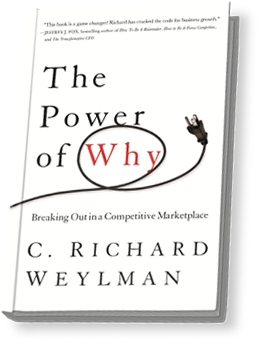
Book Review: The Power of Why, Breaking Out in a Competitive Marketplace

The Power of Why, Breaking Out in a Competitive Marketplace

By C. Richard Weylman

Hardcover:  176 pages, $24

Kindle eBook: $5.99

power of why - cover

Reviewed by Chris Wendel

Four out of Five Stars

Beyond the world of customer surveys, most companies form their marketing efforts around what the company believes of itself internally, rather than the buying motivations of paying customers. It’s safe to say that most businesses get so caught up in the day to day operations that very little effort is put forth to figure out what makes their company important  to the people that pay their bills.

This, in a broad sense,  is what sales expert and author C. Richard Weylman has in mind in his recently released book “The Power of Why, Breaking Out in a Competitive Marketplace”.  Weylman has worked in sales for decades selling everything from pots and pans door-to-door as a twenty something, to Rolls Royce cars, to eventually a sought after sales consultant. With these decades of honing his skills, Weylman has the credentials to dig in deep and get to the root of how customers’ loyalty can be earned and retained.

Weylman argues that traditional marketing has focused on developing a unique selling proposition (IE “We have great service.), which says more about what the salesperson or company thinks about their company. What new and established customers actually crave is want is what Weylman terms a “Unique Value Promise”.  The Unique Value Promise takes the unique selling proposition and digs further to find out how the company’s product or service will help customers ultimately “accomplish their outcome”.

Weyhman argues that in the 1990’s, low price replaced value for how companies position themselves to buyers.  The problem with this is twofold. First, customers have evolved to the point where they now prefer value to a lower pricing. Secondly, a company that focuses only on price, forces consumers to compare their product to their competition. The idea according to Weylman is that a Unique Value Promise will set you so far apart, that there is no competitive comparison in the eyes of the customer.

Weylman believes that organizations need to find out from customers what makes them distinct. It is recommended in the book that companies big or small interview their top 6-8 customers asking them questions about their Unique Value Promise. Asking the first question “Why do you buy from us?” will elicit a normal, not too revealing response like “You have good service”. But if this is followed up with the second question, “Why is this important to you?” which according to Weyhman will produced real (and sometimes shocking) reasons why the buyers chose them.

Michelin for example for many years market edits tires to consumers by claiming they sold steel belted radials with a better warranty than their competitors. After going through some of Weylman’s techniques the company realized that consumers actually bought Michelin tires because they kept their families safe. It didn’t take long for Michelin to supplant Goodyear whose marketing slogan had been “We’re the #1 selling tire”.

Federal Express went through a similar process back when it was trying to separate itself form UPS and DHL. Interviewing their customers they learned that the company’s pick up to delivery tracking (new at the time) assured as one customer quoted “that my package will absolutely, positively be there overnight”. This resonated so much with Federal Express that is became the main piece of their marketing effort. The book includes 40-50 of these case studies that show many more strategic techniques that go far beyond the usual “cost versus benefit” demonstration.

It’s amazing how such a straight forward concept can be missed by so many businesses. Weyhman can be quite detailed outlining his strategies, but the small investment of reading “The Power of Why “ will be appreciated by you, your employees, but most importantly your customers.

Chris Wendel is a consultant and commercial lender with Northern Initiative in Traverse City. Northern Initiatives is a private, non-profit community development corporation based out of Marquette. Northern Initiatives provides entrepreneurs with access to capital, information, and new markets.

Book Review: The Lean Entrepreneur

lean entrepreneur

How visionaries create products, innovate with new ventures, and disrupt markets

By Brant CooperPatrick Vlaskovits

Reviewed by Chris Wendel

Four out of Five Stars

“Life moves pretty fast. You don’t stop and look around, you might miss it”: Ferris Bueller, from the movie Ferris Beuhler’s Day Off

We’ve all heard the old adage that many entrepreneurs are too busy working in the business and not on their business. This is also true of startup businesses that fall in love with their new idea, but fail to recognize if there is even a market for their product or service to begin with.

With this in mind, there’s been quite a buzz in the past few years surrounding the “lean business startup”. For the uninitiated, the concept refers to validating existing market conditions and designing products and services, and then adjusting the business model as the business evolves and market conditions change. The theory relies on “validated learning” to design products or services around customer demands, without expensive product launches and huge amounts of initial funding.

The lean start-up theory became popular several years ago with the book: “The “Lean Startup” by Eric Ries.  Another second book, “The Startup Owner’s Manual” took this market validation first – product development second philosophy even further. However, both of these books tended to gravitate towards what works for technology based companies.

This leads us to “The Lean Entrepreneur”, released in early 2013, that does a better job applying the lean startup mantra to a wider range of business models.  Using its extensive case study interviews, the authors do an admirable job meshing theory with more tangible businesses examples.

For example, a fast food restaurant noticed a trend in consumers who ordering milk shakes during their long boring commute. These commuters knew that they hungry yet, but they wanted to starve off hunger until noon. The key constraints were: They had little time, they were wearing work clothes, and they had one at the most one free hand. Out of this came the solution to add fruit (to supposedly make them more nutritional) and make them thicker (so they lasted longer). The refined product therefore grew out of this “subsegment” of its customer base.

Gathering and gleaning customer information can be what the book calls a double edged sword. It can make market decisions for you, but that data must be calculated correctly and not become what is termed a “vanity metric”. A restaurant may have more than 1000 “likes” on it Facebook page, but that does not necessarily translate into customers walking through the door and ordering food.  What matters in the lean entrepreneurship model is building an audience of like-minded people who people who will drive product development, which ultimately guaranties long term financial success for the business.

Authors Cooper and Vlaskovits take great care in explaining the steps needed to understand an audience and articulate a value proposition for them, turning targeted customers into satisfied customers, and satisfied customers into passionate customers. There is also interesting discussion on how innovation can totally disrupt particular industries (iTunes in the music industry, Amazon continues to disrupt the publishing industry).

“The Lean Entrepreneur” builds on the existing lean startup methodology and provides additional applications for new business models. The book is divided into 10 chapters which detail the process. The case studies presented in each chapter are comprehensive but bring reality (at times a welcome break) to the somewhat burdensome terminology.

There is no right way to start a business, but the “The Lean Entrepreneur” will open eyes and give the aspiring entrepreneur plenty to ponder before aimlessly moving into what the book terms “The Valley of Death”, where the developed product has no customers. An established business can look at its existing customer base and use “Lean Entrepreneurship” to learn similar lessons.

When it’s all said and read, for those new to the concept of the lean startup “The Lean Entrepreneur” is important to read, but it may be repetitive to those already familiar with the world of lean startup.