
David and Goliath
Underdogs, Misfits, and the Art of Battling Giants
By Malcolm Gladwell
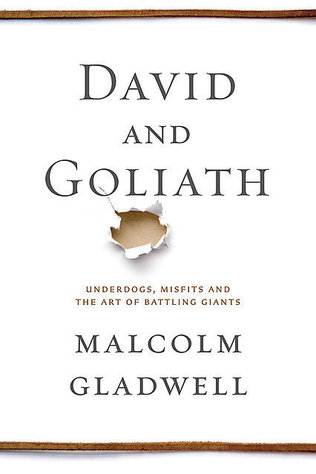
Little Brown and Company, 2013
305 pages
Hardcover: $29
E-reader version: $13
Reviewed by Chris Wendel
Bestselling author and speaker Malcolm Gladwell has written several popular books studying human behavior and its impact on social phenomenon and trends. Gladwell’s ability to look at commonly held beliefs, and do the deep dive dispel or prove that these predominant viewpoints have earned him the accolade on Time magazine’ list of most prominent people.
In Gladwell’s book The Tipping Point, he explains that magic moment when an idea, trend, or social behavior crosses a threshold, tips, and spreads like wildfire. In Outliers Gladwell highlights the 10,000 Hour Rule which posits that it takes about 10,000 hours of dedicated practice to truly master a skill be it playing the violin, computer programming, or skateboarding.
Over the past decade Gladwell has created his own sub-genre of social behavior related books. His latest offering, David and Goliath, demonstrates a similar strategy, taking mundane research and weaving it into a story that just about anyone can enjoy. A true David versus Goliath situation Gladwell explains, is not always as one sided as it appears.
These favorite/ underdog relationships go down unexpected paths when Gladwell relates it to grade school class size (a popular discussion with parents) and the point in which more money and resources leads to limited return on the investment. Gladwell delves into the topic of dyslexia and explains how in many cases this disadvantage was used to help notable people grow and accomplish things not possible without the condition including serial entrepreneur Richard Branson and investment tycoon Charles Schwab. Gladwell also identifies the surprising success of prominent individuals who succeeded despite losing a parent, including an amazing 12 of the 44 US Presidents. Each of the book’s chapters present the possibility that people facing a major disadvantage can use that shortcoming to propel them to heights they otherwise would not have achieved.
The book’s most absorbing story chronicles a group of doctors’ fight against childhood leukemia. In the early 1960’s the disease was running rampant and children with leukemia were given little chance of survival. Through determined and bold experimentation, while remaining courageous in the face of harsh criticism, the doctors were able to identify a combination of drugs that over time increased the cure rate for this type of cancer to 90%.
So, how does this all relate or pertaining to our local economy or what each or does on a daily basis? At the very least David and Goliath provides inspiration to any of us that face challenging goals and tasks, especially in an environment of limited resources and high expectations. In many respects, it’s certainly easier for a smaller company today to have a web presence that to a consumer looks just as big and just as successful as a larger corporate competitor.
This changing landscape of markets and with the ability of local companies to sell their goods and services nationally or to a worldwide audience makes it apparent that there is an opportunity for small companies to gain a competitive vantage quickly. We now live in a niche oriented society that seeks out specialized products and services that can be created by relative underdogs. Like Seth Godin’s book Tribes or the The Long Tail by Chris Anderson, the underdog role has been a reoccurring one for some time now.
The lessons to what Gladwell calls “Theory of Desirable Difficulty” turn the tables some on the traditional underdog relationship. Gladwell’s nine chapters break this down into a reframing exercise that makes it easier for a small business or organization to take on their own Goliaths.
Gladwell’s has come under heavy scrutiny of late for his broad generalities. Even if there are some holes in his methodology, David and Goliath is still a tremendous book. Is it better than his previous efforts? Maybe not. Is it a book that’s worth investing a few hours in reading? It most definitely is
Chris Wendel is a consultant and lender with Northern Initiative in Traverse City. Northern Initiatives is a private, non-profit community development corporation, based in Marquette, Michigan that provides entrepreneurs with access to capital, information, and new markets. http://www.northerninitiatives.com
 Small Business Focus