
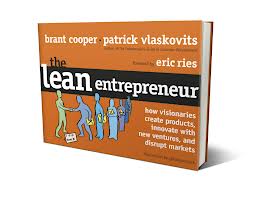
How visionaries create products, innovate with new ventures, and disrupt markets
By Brant Cooper, Patrick Vlaskovits
Reviewed by Chris Wendel
Four out of Five Stars
“Life moves pretty fast. You don’t stop and look around, you might miss it”: Ferris Bueller, from the movie Ferris Beuhler’s Day Off
We’ve all heard the old adage that many entrepreneurs are too busy working in the business and not on their business. This is also true of startup businesses that fall in love with their new idea, but fail to recognize if there is even a market for their product or service to begin with.
With this in mind, there’s been quite a buzz in the past few years surrounding the “lean business startup”. For the uninitiated, the concept refers to validating existing market conditions and designing products and services, and then adjusting the business model as the business evolves and market conditions change. The theory relies on “validated learning” to design products or services around customer demands, without expensive product launches and huge amounts of initial funding.
The lean start-up theory became popular several years ago with the book: “The “Lean Startup” by Eric Ries. Another second book, “The Startup Owner’s Manual” took this market validation first – product development second philosophy even further. However, both of these books tended to gravitate towards what works for technology based companies.
This leads us to “The Lean Entrepreneur”, released in early 2013, that does a better job applying the lean startup mantra to a wider range of business models. Using its extensive case study interviews, the authors do an admirable job meshing theory with more tangible businesses examples.
For example, a fast food restaurant noticed a trend in consumers who ordering milk shakes during their long boring commute. These commuters knew that they hungry yet, but they wanted to starve off hunger until noon. The key constraints were: They had little time, they were wearing work clothes, and they had one at the most one free hand. Out of this came the solution to add fruit (to supposedly make them more nutritional) and make them thicker (so they lasted longer). The refined product therefore grew out of this “subsegment” of its customer base.
Gathering and gleaning customer information can be what the book calls a double edged sword. It can make market decisions for you, but that data must be calculated correctly and not become what is termed a “vanity metric”. A restaurant may have more than 1000 “likes” on it Facebook page, but that does not necessarily translate into customers walking through the door and ordering food. What matters in the lean entrepreneurship model is building an audience of like-minded people who people who will drive product development, which ultimately guaranties long term financial success for the business.
Authors Cooper and Vlaskovits take great care in explaining the steps needed to understand an audience and articulate a value proposition for them, turning targeted customers into satisfied customers, and satisfied customers into passionate customers. There is also interesting discussion on how innovation can totally disrupt particular industries (iTunes in the music industry, Amazon continues to disrupt the publishing industry).
“The Lean Entrepreneur” builds on the existing lean startup methodology and provides additional applications for new business models. The book is divided into 10 chapters which detail the process. The case studies presented in each chapter are comprehensive but bring reality (at times a welcome break) to the somewhat burdensome terminology.
There is no right way to start a business, but the “The Lean Entrepreneur” will open eyes and give the aspiring entrepreneur plenty to ponder before aimlessly moving into what the book terms “The Valley of Death”, where the developed product has no customers. An established business can look at its existing customer base and use “Lean Entrepreneurship” to learn similar lessons.
When it’s all said and read, for those new to the concept of the lean startup “The Lean Entrepreneur” is important to read, but it may be repetitive to those already familiar with the world of lean startup.
 Small Business Focus